

Required plant area for a powder factory
Published on: October 26, 2023
Determining the required plant area is a critical first step in establishing an efficient and profitable powder processing facility. This foundational decision directly impacts capital expenditure, operational workflow, material handling efficiency, and future scalability. For industry professionals, the challenge lies not just in calculating square footage but in optimizing the layout to accommodate the specific grinding technology that aligns with their material, target fineness, and production goals. This article provides a strategic framework for plant area planning, focusing on how the selection of advanced grinding systems—from vertical roller mills to ultrafine solutions—can dramatically influence spatial requirements, operational costs, and overall plant footprint. By understanding the intrinsic relationship between equipment design and facility layout, investors can make informed decisions that maximize productivity per square meter.
The traditional approach to powder plant design often involved sprawling layouts to house separate units for crushing, drying, grinding, and classification. This not only consumed vast tracts of land but also introduced complexities in material transfer, increased energy loss, and elevated construction costs. The modern paradigm, championed by integrated grinding systems, shifts towards compact, multi-functional plants. The core of this efficiency lies in selecting equipment engineered for a small footprint without compromising on output or quality.
Consider the transformative impact of a Vertical Roller Mill (LM Series). Its design philosophy integrates crushing, drying, grinding, powder separation, and conveying into a single, cohesive unit. This integration is a game-changer for spatial economics. As the technical data indicates, such a system typically requires about 50% less floor space compared to a conventional ball mill system of equivalent capacity. The compact, vertical structure allows for outdoor installation in many cases, further freeing up valuable enclosed building space for other processes like packaging, warehousing, or quality control labs. This consolidation directly translates to reduced civil engineering costs, shorter material conveyance paths, and a more streamlined plant workflow.

For operations targeting high-volume production of powders in the 30-400 mesh range, such as for desulfurization limestone or slag micro-powder, the MTW European Trapezium Mill presents another spatially intelligent solution. Its design features, like the cone gear whole transmission, eliminate the need for bulky external reducers and complex drive assemblies, resulting in a more compact drive section. The efficient arc air duct design minimizes the space required for airflow management. When planning your plant, allocating area for such a mill means accounting not just for the mill itself but for the reduced ancillary space—smaller motor rooms, simpler ducting routes, and less area dedicated to maintenance access for external gearboxes.
The pursuit of ultrafine powders (325-4000 mesh) for advanced materials like new energy components or high-grade fillers introduces different spatial considerations. Equipment like the SCM Ultrafine Mill and LUM Ultrafine Vertical Mill are designed for precision. While their physical footprint might be comparable to other mills, their area requirement is influenced by the need for ultra-clean, stable environments. Their advanced sealing systems and negative pressure operation contain dust effectively, which can reduce the need for extensive, separate containment structures or oversized dust collection rooms. The intelligent control systems allow for remote operation, potentially centralizing the control room and reducing the floor space needed for localized operator stations around each mill.
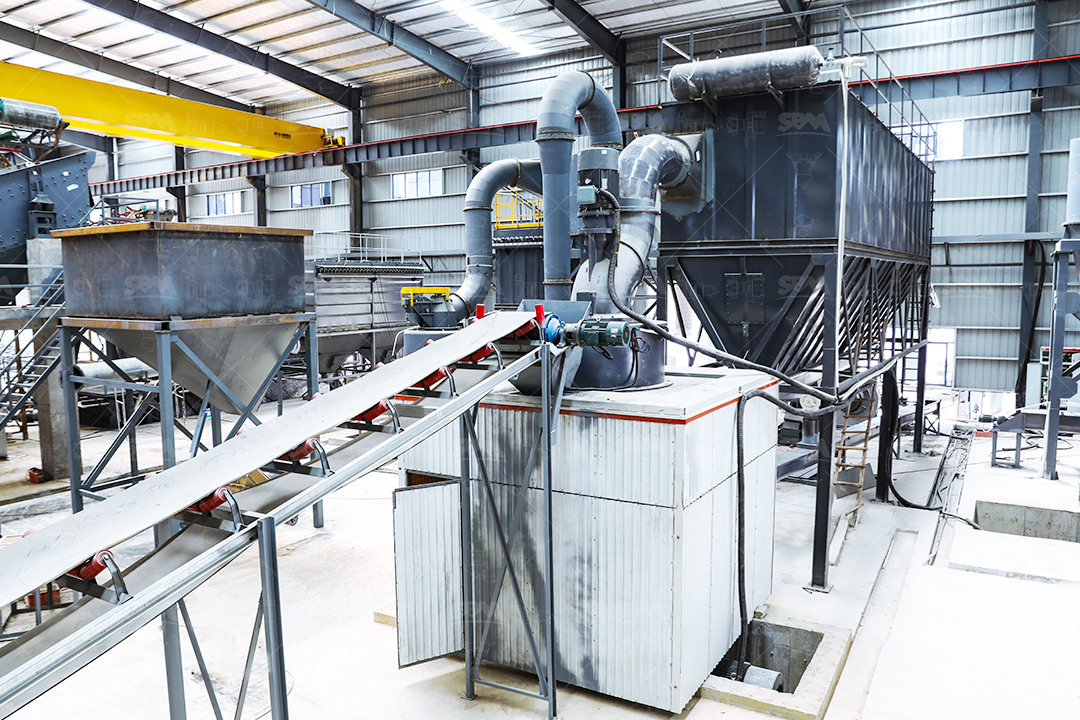
A holistic plant area assessment must extend beyond the primary grinder. Key supporting infrastructure includes: raw material pre-homogenization yards, finished product silos (whose height and diameter are capacity-dependent), bagging/packing stations, maintenance workshops, and utility rooms for compressors and electrical systems. The choice of grinding technology affects these too. A system with higher grinding efficiency and lower energy consumption, like the Vertical Roller Mill which uses 30-40% less energy than a ball mill, may allow for a smaller power distribution room and transformer substation. Similarly, equipment with superior wear resistance (featuring unique roller/ring materials or curved shovel blade designs) will have a smaller on-site spare parts inventory footprint.
Ultimately, defining the required plant area is an exercise in total cost of ownership optimization. A marginally larger initial plot to accommodate a more modular, less integrated system might seem economical but often leads to higher long-term operational costs through energy loss, maintenance complexity, and lower labor efficiency. Conversely, investing in a technologically advanced, integrated grinding solution from a provider with global application expertise can compress the active production area, enabling a smaller, smarter, and more sustainable facility. This strategic compression frees up capital and space for value-adding expansions or simply creates a more manageable and cost-effective production asset.
Frequently Asked Questions (FAQs)
Q1: We have limited land availability. Can we still build a high-capacity powder plant?
A: Absolutely. Modern integrated mills, particularly Vertical Roller Mills, are designed for high capacity in a compact footprint. Their vertical, all-in-one design can reduce the grinding system's floor space by up to 50% compared to traditional setups, making them ideal for space-constrained greenfield or brownfield sites.
Q2: How does equipment selection affect long-term operational costs related to plant layout?
A: Profoundly. Equipment with high energy efficiency lowers utility demands. Designs with exceptional wear part longevity (like those with special material rollers/rings) reduce the frequency and volume of spare part deliveries and storage. Furthermore, automated control systems enable centralized operation, reducing the need for personnel to be physically spread across a large plant area, thereby saving on labor costs.
Q3: We need to produce multiple powder fineness grades. Will this require a much larger plant?
A: Not necessarily. Advanced mills with highly adjustable classifiers, such as the LUM Ultrafine Vertical Mill with its multi-rotor powder classifier, allow for quick fineness adjustment within a single machine. This flexibility means you may not need separate production lines for different products, significantly saving space compared to a multi-line, dedicated-machine approach.
Q4: Is outdoor installation of major grinding equipment feasible, and how does it impact area planning?
A: Yes, many contemporary mills are built for outdoor installation with proper weather protection. This is a major area-saving strategy. It allows you to dedicate enclosed building space only to processes that strictly require it (e.g., final packaging, labs), while the primary grinding and classification happen outdoors, drastically reducing building envelope costs and freeing up your covered area.
Q5: How can we future-proof our plant area for potential capacity expansion?
A: Smart initial planning is key. Select equipment with a capacity range that offers headroom. More importantly, choose a technology platform known for modularity. Working with a solution provider that offers scalable systems allows you to plan the initial layout with expansion bays or utility connections in mind, enabling future capacity increases without a complete plant redesign or disproportionate new land acquisition.


