

Limestone: from natural formation to industrial use
Published on: 2025-03-28
Limestone, a sedimentary rock primarily composed of calcium carbonate (CaCO₃), originates from the accumulation of marine organism shells and coral over millions of years. Its natural formation results in a versatile material that, after extraction and processing, becomes indispensable across industries such as power generation, building materials, mining, metallurgy, chemicals, and non-metallic minerals. At SBM Machinery, we have spent decades refining the grinding technologies that transform raw limestone into high-value powders for applications like environmental desulfurization, heavy calcium carbonate (GCC) production, coal powder preparation, and new energy materials. Our MTW European Trapezium Mill, LM Vertical Roller Mill, SCM Ultrafine Mill, LUM Ultrafine Vertical Mill, and Ball Mill each address specific customer pain points — from high energy consumption and low output to wear part longevity and fineness control. This article explores the journey of limestone from geological formation to industrial utilization, highlighting the engineering solutions that make modern processing efficient, cost-effective, and environmentally responsible.
_1783441167736.jpg)
Natural formation and composition of limestone
Limestone forms in shallow, warm marine waters through both biological and chemical processes. Over geological timescales, the calcium carbonate skeletons of organisms like corals, foraminifera, and mollusks accumulate on the seabed, compacting under pressure to form rock. Impurities such as clay, sand, organic remains, iron oxide, and other materials can influence its color and hardness, affecting downstream processing. The purity of limestone determines its suitability for industrial uses — high-calcium limestone (above 95% CaCO₃) is preferred for cement, steelmaking, and flue gas desulfurization, while dolomitic limestone (containing magnesium carbonate) finds use in agriculture and refractory applications. Understanding these variations is critical for selecting the right grinding equipment and achieving desired product specifications.
Quarrying and primary crushing
Once a limestone deposit is identified through geological surveys, extraction begins via drilling, blasting, and mechanical ripping. The run-of-mine rock, typically ranging from 300 mm to 1 meter in diameter, undergoes primary crushing in jaw or impact crushers to reduce size to 0-50 mm, suitable for feeding into grinding mills. At this stage, moisture content can vary (usually 2-6%), which influences the drying requirements in subsequent milling. SBM’s LM Vertical Roller Mill excels here due to its integrated drying, grinding, and classification functions, handling materials with up to 15% moisture without pre-drying — a key advantage for customers dealing with wet limestone in humid climates or from washing processes.
Grinding technologies for limestone powder
Limestone grinding involves reducing particles to specific size distributions — from coarse 30 mesh (600 μm) for steelmaking to ultra-fine 2500 mesh (5 μm) for plastics and coatings. Each application demands tailored solutions.
MTW European Trapezium Mill for medium-fine grinding
For customers producing 30-400 mesh powders at 3-40 tph, the MTW mill offers a robust solution. Its cone gear whole transmission eliminates belt slippage and reduces maintenance, while the arc air duct design minimizes energy loss — directly addressing the common pain point of high operating costs. The combined-type shovel blade only requires replacing the blade tip during maintenance, cutting downtime and spare part expenses. Clients in the power industry using limestone for desulfurization often prefer MTW for its reliability and consistent product fineness under continuous operation.
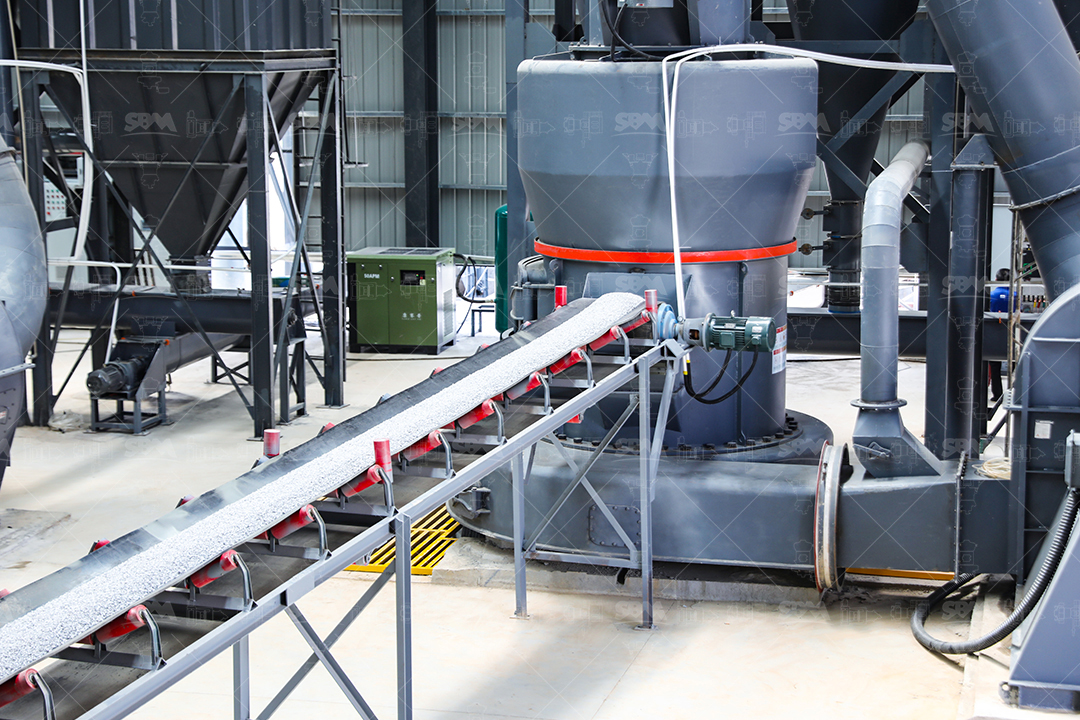
LM Vertical Roller Mill for large-scale production
With capacity reaching 400 tph and input size up to 50 mm, the LM mill is designed for high-throughput operations. Its integrated system (crushing, drying, grinding, classifying) reduces floor space by 50% compared to ball mill systems — a critical benefit for plants with space constraints. Lower energy consumption (30-40% less than ball mills) and automatic control systems help operators reduce labor costs and achieve stable product quality. Customers in cement and steel industries, where limestone powder is consumed in massive quantities, frequently choose LM mills to lower overall investment and operational expenses.
SCM Ultrafine Mill for fine and ultra-fine grinding
For fineness requirements from 325 to 2500 mesh, the SCM mill delivers D97≤5 μm in a single pass — surpassing traditional Raymond mills. Its heavy rotor design and special wear-resistant materials increase roller and ring durability, addressing the pain point of frequent part replacement. High output (twice that of jet mills) with 30% lower energy consumption makes it ideal for GCC processing and non-metallic mineral industries. The pulse dust collector system ensures emissions meet stringent environmental standards, a growing concern for operators worldwide.
LUM Ultrafine Vertical Mill for high-end applications
Designed for ultra-fine grinding of calcite, marble, limestone, and similar minerals, the LUM mill combines Taiwanese roller technology and German classification techniques. Its multi-rotor classifier allows precise fineness adjustment between 325 and 2500 mesh with no low-grade material contamination — a crucial advantage for PVC, cable, and artificial stone manufacturers who require consistent particle distribution. PLC/DCS automatic control ensures stable operation and remote monitoring, reducing skilled labor dependency.
Ball Mill for conventional powder production
While ball mill technology is mature, SBM’s optimized versions address common complaints: wear-resistant linings and grinding media reduce metal ball consumption and energy costs. Dry and wet configurations suit different processing needs, from common building materials to mineral dressing. Customers with existing ball mill infrastructure often upgrade to our systems for improved reliability and lower spare part expenses.
Industrial applications and customer benefits
Limestone powder finds its way into countless products and processes:
- Flue gas desulfurization (FGD): Power plants use 200-325 mesh limestone slurry to remove SO₂ emissions. Our MTW and LM mills provide consistent fineness and high throughput, ensuring compliance with emission regulations.
- Building materials: Cement, mortar, and artificial stone require finely ground limestone as filler or reactant. SCM ultrafine mills enable precise particle size control for enhanced product strength.
- Plastics, rubber, and paints: Ultra-fine GCC (1-5 μm) improves opacity, impact resistance, and processing. LUM mills deliver the quality demanded by high-end polymer applications.
- Agriculture: Coarse limestone (30-100 mesh) neutralizes acidic soils. Our ball mills produce cost-effective aglime with minimal fines.
- Environmental protection: Limestone-based absorbents treat acid mine drainage and industrial wastewater. Customized grinding solutions from SBM ensure reactivity and cost-efficiency.
Conclusion
Limestone’s journey from natural formation to industrial application relies on advanced grinding technologies that address real-world challenges: high energy costs, wear part longevity, space limitations, environmental compliance, and fineness consistency. SBM Machinery’s portfolio — MTW, LM, SCM, LUM, and Ball mills — provides tailored solutions for every scale and requirement. With over 180 countries served and decades of R&D, our equipment has become the preferred choice for global powder processing. Whether you need 30 mesh for steelmaking or 2500 mesh for advanced materials, our integrated approach from quarry to finished product minimizes your total cost of ownership.
FAQ
Q1: My limestone contains high moisture. Which mill can handle it without pre-drying?
A: The LM Vertical Roller Mill is ideal. It integrates drying, grinding, and classification, handling materials with up to 15% moisture. Hot air from the system removes moisture during grinding, eliminating the need for separate drying equipment and reducing operating costs.
Q2: Why is my current ball mill consuming too much power and wearing out grinding media quickly?
A: SBM’s optimized ball mill features wear-resistant liners and high-quality grinding media that reduce consumption. However, if you process 30-400 mesh powders, consider switching to our MTW or LM mills, which use 30-40% less energy and avoid metal-to-metal contact, extending roller life significantly.
Q3: I need limestone powder with fineness D97≤5 microns for plastic filler. Which equipment guarantees this consistently?
A: The SCM Ultrafine Mill or LUM Ultrafine Vertical Mill can achieve D97≤5 μm in one pass. Both feature high-precision classifiers and automatic control systems to maintain product consistency. The LUM mill is particularly suited for high-end applications requiring narrow particle distribution and no contamination.
Q4: Our plant has limited space. How can we set up a complete grinding system without expanding the building?
A: The LM Vertical Roller Mill has a compact footprint — about 50% less than traditional ball mill systems. It integrates crushing, drying, grinding, and classifying in one unit, and can be installed outdoors with weather protection. This significantly reduces civil construction and layout constraints.
Q5: What maintenance issues should I expect with your grinding mills, and how do you minimize downtime?
A: For MTW mills, the combined shovel blade design only requires replacing the blade tip, not the entire assembly, reducing downtime and spare part costs. LM mills use rollers that do not contact the grinding plate directly, minimizing wear. All our mills include automatic lubrication systems and easy-access inspection doors, and our global service network provides prompt support.


