

Complete guide to limestone grinding processes and equipment selection
Posted on February 18, 2025
Limestone grinding is a critical step in many industries, from power generation and construction to mining and chemical processing. Whether you're producing desulfurization powder for environmental systems, heavy calcium carbonate for fillers, or fine powders for new energy materials, the efficiency and reliability of your grinding process directly impact your bottom line. This guide offers a complete overview of limestone grinding — covering key processes, equipment options, and practical selection criteria — based on decades of engineering experience and customer feedback across more than 180 countries. You'll learn how to match your specific feed size, output fineness, capacity, and energy goals to the right mill, avoiding common pitfalls like high operating costs, frequent downtime, and inconsistent product quality. By the end, you'll have a clear roadmap to optimize your limestone grinding operation, whether you're upgrading an existing line or building from scratch.
1. Understanding Limestone Grinding Processes
Limestone grinding is essentially the process of reducing quarried limestone rock into a fine powder or slurry, depending on the downstream application. The process involves three main stages: crushing, grinding, and classification (or powder selection). While the basic principle is simple — feed material into a mill, grind it, and collect the fine particles — the real challenge lies in optimizing each stage to achieve the desired fineness and throughput with minimal energy consumption and wear.
For typical industrial use, limestone feed sizes range from 0 to 50 mm, and required output fineness can vary anywhere from 30 mesh (about 595 microns) for coarse applications to 2500 mesh (about 5 microns) for ultra-fine products. The relationship between feed size, product fineness, and throughput capacity is the core tension that dictates equipment choice. For instance, a plant producing standard desulfurization powder (200-325 mesh) at 20 tons per hour will require a very different setup than a plant making ultra-fine GCC for plastics at 5 tons per hour.
Beyond the physical grinding, the process also includes important auxiliaries: feeding systems that ensure consistent material flow, dust collection for environmental compliance, and classification systems that return oversized particles to the mill. A well-designed grinding circuit integrates these components to maintain stable operation and product quality. Neglecting any one part can lead to bottlenecks, product inconsistency, or even shutdowns.
Another critical process consideration is moisture content. Limestone often contains surface moisture from quarrying, especially in humid climates. For dry grinding, this moisture must be evaporated inside the mill, which requires hot air or increased air flow. Some mill types, like vertical roller mills, have integrated drying capability, making them more versatile for wetter feeds. This is a key factor when evaluating equipment for your operation.
2. Key Equipment for Limestone Grinding
Choosing the right grinding mill is the most important decision in your process design. Over the years, four main types of mills have proven themselves in limestone grinding, each with distinct strengths and application domains.
European Trapezium Mill (MTW)
The MTW series European trapezium mill is a classic Raymond mill upgrade, specifically engineered to address the weaknesses of traditional pendulum mills. It uses a bevel gear whole transmission system, which saves space and increases transmission efficiency. The arc-shaped air duct reduces air flow losses and boosts material transport efficiency. The unique curved shovel blade design extends the life of grinding rollers and rings by optimizing the feeding angle, reducing replacement frequency and ongoing maintenance costs. MTW mills handle input sizes up to 50 mm and produce fineness from 30 to 400 mesh, with capacities from 3 to 40 tons per hour. They are ideal for medium-capacity operations where simplicity and cost-effectiveness are priorities. Many customers in desulfurization powder preparation and building materials choose MTW for its balance of performance and investment.
LM Vertical Roller Mill
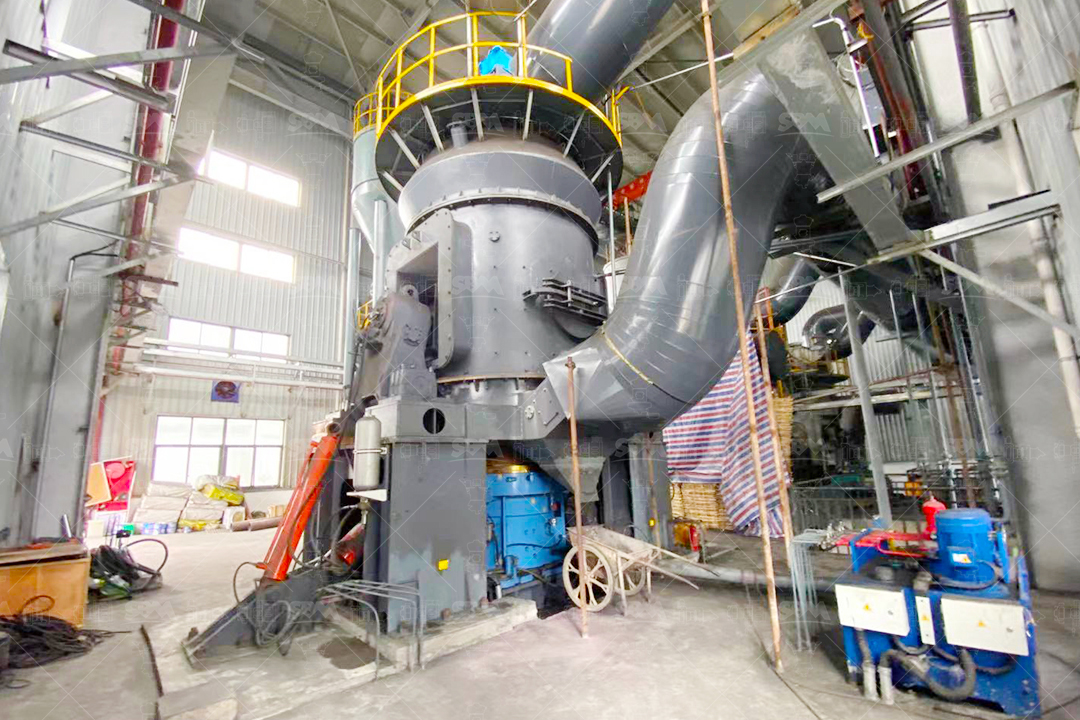
The LM vertical roller mill represents a completely different grinding principle. Instead of using centrifugal force to press rollers against a ring, it uses hydraulic pressure to press rollers onto a flat grinding table. This design offers several major advantages. First, the system integrates crushing, drying, grinding, and powder separation into one unit, occupying only about 50% of the floor space of a ball mill system. Second, since the rollers don't directly contact the grinding table, wear is significantly reduced. Third, energy consumption is 30-40% lower than ball mills. The LM mill also has a strong drying capability, making it suitable for materials with higher moisture. It handles up to 50 mm feed, outputs 30-400 mesh, and covers a wide capacity range from 3 to 400 tons per hour. This is the go-to solution for large-scale grinding operations where efficiency and footprint matter most, such as in cement, coal, and metallurgical industries.
SCM Ultrafine Mill
For customers who need ultra-fine powders — specifically above 325 mesh — the SCM series ultrafine grinding mill is the answer. It was developed as a response to the limitations of general Raymond mills, which struggle to produce fine and consistent products. The SCM mill can adjust output fineness between 325 and 2500 mesh, with a disposable fineness reaching D97≤5 microns, a leading standard in the industry. It achieves double the capacity of a jet mill while consuming 30% less energy. The vertical turbine powder classifier ensures accurate particle size distribution with no coarse powder spillover. Special materials for the grinding roller and ring dramatically extend wear life. Capacities range from 0.5 to 25 tons per hour. SCM mills are widely used in ultra-fine GCC processing, and they have become a standard choice for plastic masterbatch, PVC, artificial stone, and other high-end applications where product quality is non-negotiable.
_1786897200983.jpg)
LUM Ultrafine Vertical Mill
If you require ultra-fine grinding with high throughput, the LUM ultrafine vertical mill offers a hybrid solution. It builds on the proven vertical roller mill architecture but incorporates advanced grinding roller technology from Taiwan and German powder separation technology to achieve ultra-fine outputs. The design of the grinding roll shell and lining plate is uniquely curved to facilitate the formation of a stable material bed, enhancing grinding efficiency and the proportion of primary finished products. A multi-rotor powder classifier allows for precise fineness adjustment from 325 to 4000 mesh, and the PLC/DCS control system automatically adjusts grinding pressure, disc speed, and classifier speed for stable operation. The entire system is sealed and under negative pressure, ensuring zero dust spillage and low noise. With capacities from 10 to 70 tons per hour, LUM mills are the premium choice for high-end mineral powder processing, especially in plastics, non-woven fabrics, and other polymer-related industries.
Ball Mill (with Modern Optimizations)
Ball mills have been used in limestone grinding for over a century, and they remain in operation in many plants due to their reliability. However, traditional ball mills face known drawbacks: high energy consumption and significant wear of grinding media. Modern optimizations have addressed these issues. For example, new material technology for liners and grinding media extends service life, and improved structure design reduces the cost of spare parts. Ball mills are still a viable option for coarse-to-medium grinding (output around 0.2-0.074 mm) and are especially common in wet grinding applications where a slurry product is required, such as in mineral dressing. They also serve as a low-tech, low-maintenance solution in some smaller operations. However, for new installations or upgrades involving dry grinding, vertical mills or ultrafine mills are generally more efficient choices.
3. How to Select the Right Equipment for Your Needs
Selecting the optimal limestone grinding mill requires a systematic analysis of several key parameters. Here's a practical framework to guide your decision-making.
First, define your product fineness and capacity targets. Clearly specify the required D50 and D97 particle sizes of your final powder, as well as your desired throughput in tons per hour. This alone will rule out many options. For instance, if you need 90% passing 200 mesh at 30 tph, an SCM or LUM mill would be overkill, and a ball mill would struggle with efficiency — the MTW or LM would be your prime candidates. Conversely, for ultra-fine products below 5 microns, only SCM or LUM mills can perform economically.
Second, evaluate your feed material properties. Consider the moisture content, hardness, and abrasiveness of your limestone. High moisture feeds (above 5%) typically require a mill with strong drying capability like the LM or LUM. Harder limestone may need increased grinding pressure, which favors the robust construction of LM and LUM mills. Also, consider the feed size — larger lumps (above 40 mm) might require pre-crushing or choose a mill like MTW that handles up to 50 mm inputs directly.
Third, consider your available space and layout constraints. If you're retrofitting into an existing building, a vertical mill's compact footprint and outdoor installation capability could be a deciding factor. Ball mill systems have the largest footprint and require special foundations. MTW mills are intermediate in size but need more head room than vertical mills.
Fourth, prioritize energy efficiency and environmental compliance. Energy costs are often a plant's largest variable expense after raw materials. Vertical roller mills are widely recognized as the most energy-efficient option, consuming 30-40% less energy than ball mills. They also offer superior environmental performance, with sealed operation and effective dust collection. If your project faces strict emission regulations, choose a mill with fully sealed negative pressure operation and integrated dust collection systems (like LM, LUM, or SCM).
Fifth, think about long-term maintenance and operating costs. Wear parts will always need replacement, but their frequency and cost vary significantly. MTW mills feature replaceable shovel blades, which are lower cost than full grinding rolls. LM and LUM mills use high-quality materials for rollers and table, resulting in longer intervals between changes but with higher piece costs. SCM mills use special alloys for the grinding ring and roller, offering several times the durability. Factor in both the cost of parts and the downtime required for maintenance. Some mills are designed for quick access and easy replacement, which reduces labor costs and production loss.
Finally, always consult with equipment manufacturers who have application engineers and field experience. A reputable supplier like SBM Machinery, with over 180 countries served, will conduct tests on your actual limestone samples to determine the optimum mill type and settings. They can also simulate your process and provide a detailed layout of the grinding plant, including the feeding system, dust collector, and product handling. This upfront engineering collaboration is invaluable in avoiding expensive mistakes and ensuring your process runs at peak performance from day one.
4. Final Thoughts and Best Practices
Limestone grinding is a mature but evolving field. The right equipment choice — based on your specific fineness, capacity, and operational constraints — is the foundation of a successful grinding plant. In our experience, the most common mistakes we see are oversizing a mill to meet peak demand (leading to low efficiency and high energy per ton), or undersizing around future expansion plans, which creates costly bottlenecks later. A balanced approach, considering both current needs and moderate future growth, yields the best long-term value.
We also strongly emphasize the importance of system integration. A mill is only one part of a grinding system that includes feeding, conveying, dust collection, and powder classification. The best mills can still produce poor results if the surrounding components are not optimized. Work with a supplier who offers total solutions — from individual units to complete grinding systems — to ensure all components are designed to work together seamlessly.
Another best practice is to implement an automatic control system with remote monitoring capabilities. Modern mills like the LM and LUM come with PLC/DCS systems that adjust grinding pressure, disc speed, and classifier speed in real time, ensuring consistent product quality with minimal operator intervention. This not only saves labor costs but also adapts to slight variations in feed material, keeping your product within specification.
Finally, never underestimate the value of local support and after-sales service. Grinding equipment is a long-term investment that requires technical support, spare parts availability, and maintenance expertise over the life of the plant. Choose a partner who has a proven track record in your country or region and can provide timely support when you need it.
By following these guidelines and partnering with an experienced total solution provider, you'll be well-equipped to optimize your limestone grinding process and achieve the perfect balance of product quality, energy efficiency, and operating cost reduction.
5. Frequently Asked Questions (FAQ)
Q1: My limestone feed has high moisture (up to 8%). Which mill should I choose?
High moisture content above 5% requires a mill with strong drying capability. We recommend the LM vertical roller mill or LUM ultrafine vertical mill, as both are designed with integrated drying, grinding, and separation functions. They use hot air flow to evaporate moisture inside the mill chamber, ensuring continuous operation without material sticking or clogging. The MTW mill can handle up to 3-4% moisture with higher air flow, but for 8% moisture, vertical mills are the safest choice.
Q2: What is the biggest cause of high operating costs in limestone grinding, and how can I reduce it?
The biggest cost factor is typically energy consumption, especially when using conventional ball mills or inefficient Raymond mills. These systems waste energy in friction and unproductive impact, often consuming 30-40% more electricity than vertical roller mills. Another major cost is wear part replacement frequency. To reduce costs, switch to high-efficiency mills with integrated drying and classification, and use wear-resistant materials for grinding rollers and rings. Additionally, maintain an optimal feeding rate and grinding pressure via automatic control systems to avoid over-grinding. A detailed cost analysis by your equipment supplier will help identify the exact reduction areas unique to your plant.
Q3: I need to produce fine powder at 600 mesh (D97 ≤25 μm) at 8 tons per hour. Which equipment do you suggest?
For ultra-fine powder at 600 mesh with a capacity of 8 tph, we suggest either the SCM ultrafine mill or LUM ultrafine vertical mill, depending on your specific requirements. The SCM mill is highly flexible and energy-efficient for capacities up to 25 tph, with fineness adjustable from 325 to 2500 mesh. The LUM mill is more suitable if you prefer a vertical mill system with higher throughput potential and a compact footprint. Both are proven for heavy calcium carbonate and other ultra-fine applications. To choose between them, consider your available space and whether you prefer a mobile or stationary setup — we can perform a sample test to validate the exact performance.
Q4: Why does my current mill produce inconsistent particle size distribution, with occasional coarse particles?
Inconsistent particle size is often caused by insufficient powder classification. In many mills, the classifier either has a low separation efficiency or allowed coarse particles to spill over into the finished product. Additionally, unstable feeding rates or variable feed hardness can lead to irregular grinding conditions. The solution is to upgrade your mill with a high-efficiency vertical turbine classifier (like in the SCM or LUM mills), which uses frequency conversion to precisely control the cut size. Also, ensure your mill has automatic control of grinding pressure and disc speed to maintain stable conditions. Our engineers can conduct a diagnostic audit to pinpoint the root cause and implement corrective actions.
Q5: Is it necessary to buy a complete grinding system, or can I use my existing auxiliary equipment for a new mill?
It's possible to reuse some existing equipment, like storage silos, conveyors, and certain dust collectors, if they are in good condition and compatible with the new mill's requirements. However, we strongly advise a professional assessment of your current system's capacities, pressure drop, and air flow to ensure they match the new mill. Mismatched auxiliaries — for example, an undersized dust collector or a feeder that can't maintain a consistent feed rate — will limit mill performance and may cause operational problems. A total solution provider like SBM can evaluate your existing equipment and provide an integrated design that optimizes performance while minimizing unnecessary replacement costs. Our goal is to help you achieve the best balance between new and reused equipment for maximum ROI.


