

Complete process flow of basalt grinding
Published: March 21, 2025
Basalt, one of the most abundant volcanic rocks on Earth, is increasingly recognized as a valuable raw material across construction, mining, chemical, and metallurgical industries due to its hardness, durability, and thermal stability. However, transforming this tough, abrasive rock into fine, market-ready powder is no trivial task—it demands a carefully engineered process flow that balances crushing efficiency, grinding precision, energy consumption, and product consistency. In this comprehensive guide, we walk through the complete process flow of basalt grinding, drawing on decades of field experience and advanced mill technologies. You will learn how material properties influence equipment selection, how each stage—from primary crushing to ultrafine classification—contributes to the final product quality, and why modern grinding systems such as trapezium mills, vertical roller mills, and ultrafine mills offer measurable advantages in capacity, energy efficiency, and operational reliability. Whether you are producing road base aggregates, cement additives, or fine powders for composite materials, understanding this process is your first step toward optimizing throughput, reducing downtime, and achieving consistent quality.
---
1. Understanding Basalt and Its Grinding Challenges
Basalt is a dark, fine-grained igneous rock with high compressive strength (typically 200-350 MPa) and high silica content (45-55%). Its abrasive nature and hardness make it one of the most challenging materials to grind. Key physical properties that directly affect the grinding process include:
- High hardness (Mohs scale 5-7) – requires high wear-resistant grinding media and liners.
- Moisture content – surface moisture can cause clogging in screens and classifiers.
- Crystalline structure – basalt's interlocking crystals can cause uneven fracture, leading to variable particle size distribution.
- Abrasiveness – accelerates wear of rollers, rings, and other contact parts unless specific alloy steels or tungsten carbide coatings are used.
Given these characteristics, a single-stage grinding process is rarely efficient. Instead, a well-designed multi-stage flow that integrates crushing, drying, grinding, classifying, and dust collection is essential to achieve the desired fineness and throughput.
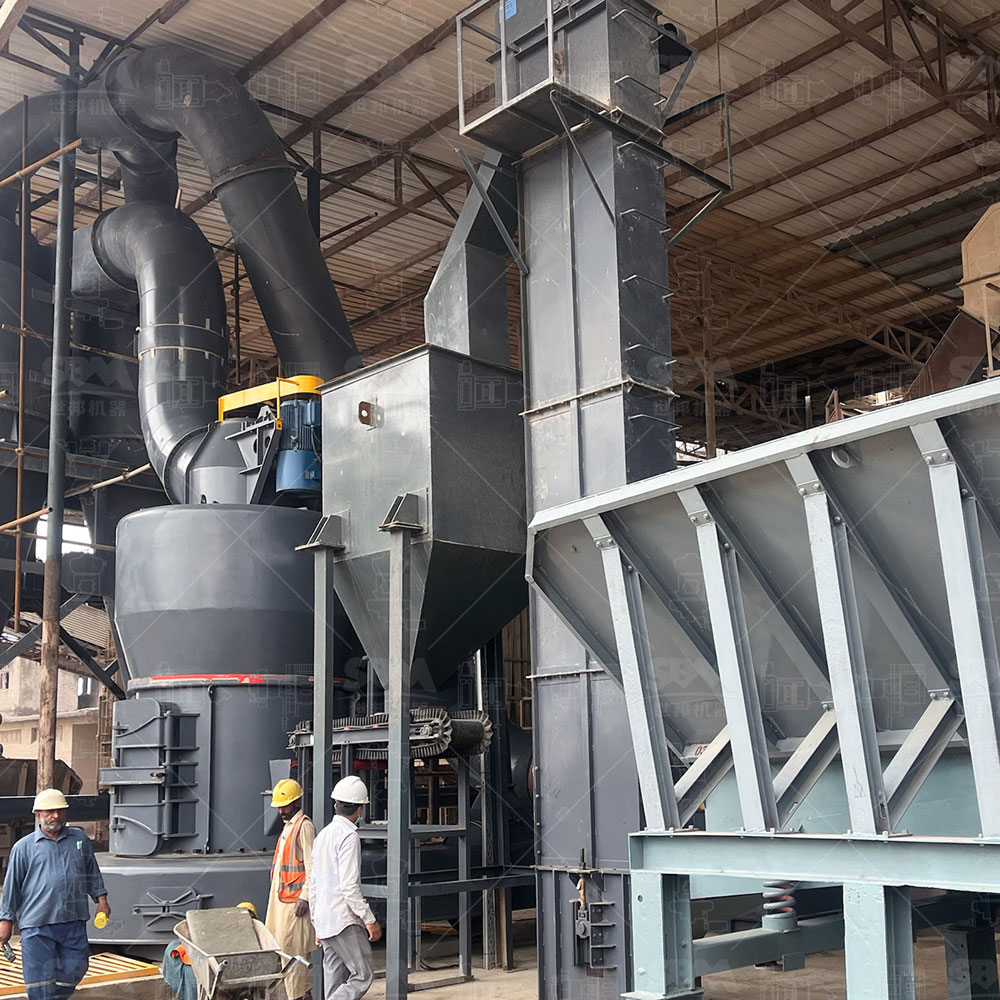
---
2. Overview of the Complete Process Flow
While individual setups may vary, the complete basalt grinding process flow consists of six core stages:
- Primary Crushing – reducing run-of-mine (ROM) basalt to manageable sizes (0-50 mm).
- Belt Conveying & Pre-Homogenization – ensuring consistent feed composition and moisture control.
- Grinding (Main Unit) – using an appropriate mill to reduce particles to target fineness (from 30 mesh to 2500 mesh).
- Classification – separating fine product from oversize particles using dynamic classifiers.
- Dust Collection & Ventilation – high-efficiency bag filters or cyclone collectors ensure environmental compliance and product recovery.
- Storage & Packaging – homogenizing silos, automatic packing, and load-out systems.
Each stage interacts with the next. For example, moisture content influences drying requirements; feed size dictates crusher settings; and target fineness determines whether you use a Raymond mill, trapezium mill, vertical roller mill, or ultrafine mill.
---
3. Stage-by-Stage Detailed Breakdown
3.1 Primary Crushing and Screening
Basalt boulders from quarries can exceed 500 mm. A jaw crusher (e.g., SBM's PE series) or impact crusher reduces these to 0-50 mm. This step is critical because overfeeding large blocks into any grinding mill causes mechanical stress and frequent downtime. In practice, we recommend a two-stage crushing circuit: first jaw crushing (coarse), then a cone crusher or impact crusher to achieve the feed size target of your mill.
Screening: after crushing, a vibrating screen separates fines (<50 mm) from oversize. The oversize is returned for re-crushing. The screened material should be stored in a covered bunker to minimize rainfall ingress, as even 5% surface moisture can reduce grinding efficiency by up to 15%.
3.2 Grinding Mill Selection Based on Product Fineness
This is the core decision point. Different industries require different final fineness:
- Coarse powder (30-100 mesh) for road base, asphalt aggregate, or as a construction filler – an MTW European Trapezium Mill or a Ball Mill works well.
- Medium fineness (100-400 mesh) for cement additives, plastics, rubber – an LM Vertical Roller Mill or MTW Mill is ideal due to their high capacity and moderate energy consumption.
- Fines (400-800 mesh) for paints, adhesives, polymer compounds – the SCM Ultrafine Mill or LUM Ultrafine Vertical Mill can achieve D97 ≤ 5-10 microns.
We have observed many clients make the mistake of choosing a generic mill without considering the hardness and abrasiveness of basalt. For example, using a conventional Raymond mill without reinforced wear parts can lead to frequent roller and ring replacement—every 3-6 months. In contrast, the MTW trapezium mill's curved shovel blade and reinforced grinding roller reduce wear by up to 40%, lowering operational costs.
3.3 Drying Inside the Mill
Basalt typically contains less than 8% natural moisture. However, in humid climates or after washing, moisture may be higher. Both the MTW and LM vertical mills are designed with integrated hot air supply. The rotary airlock feeders introduce heated gas (often from a hot air furnace) into the mill; as the material moves through the grinding zone, the high temperature and air velocity evaporate moisture, ensuring product dry enough for classification.
For the LM vertical roller mill, one of its major advantages is its ability to handle feed moisture up to 15%, because the hot air system is built into the mill body. This means you don’t need a separate dryer—saving floor space and capital cost.
_1787502062630.jpg)
3.4 Classification and Recirculation
After grinding, the material-air mixture rises to a dynamic classifier (either a single-rotor or multi-rotor type). For the MTW mill, an adjustable speed classifier allows you to control fineness within 30-400 mesh. The coarse particles are rejected and fall back to the grinding table for re-grinding; fine particles are conveyed to the cyclone collector.
For higher fineness (above 400 mesh), the SCM ultrafine mill uses a turbine classifier that can rotate at very high speeds, producing powder with extremely narrow particle size distribution. This is critical for applications like plastics or artificial stone, where consistent particle size determines melt flow and final strength.
3.5 Dust Collection and Environmental Compliance
Modern basalt grinding plants must meet stringent environmental regulations. We incorporate a two-stage dust collection system: primary cyclone collectors and high-efficiency pulse-jet bag filters. The bag filter captures particles down to 0.1 micron, ensuring emission concentrations below national standards. In closed-loop systems, the cleaned air is recirculated to the furnace or exhausted through a stack, minimizing heat loss and environmental impact.
Additionally, the system operates under negative pressure. This not only prevents dust leakage from pipe joints but also improves safety against explosion in case of combustible dust (though basalt is inert, any powder can become explosive if concentrations are high).
---
4. Equipment Options and Selection Guide
Based on our extensive project experience across 180 countries, we recommend three primary mills for basalt grinding. Each has distinct advantages:
MTW European Trapezium Mill
Ideal for: Finished fineness 30-400 mesh, capacity 3-40 t/h.
Advantages: Cone gear full transmission reduces energy consumption by 20-30% compared to traditional Raymond mills. Unique arc air duct avoids energy loss and reduces wear. The internal oil absorption lubrication system eliminates the need for oil pumps, simplifying maintenance.
Why for Basalt: The high-pressure curved shovel blade helps control material feed angle, reducing vibration even when grinding hard basalt. The large-diameter grinding rollers and rings use high-chromium alloy, extending service life up to 2-3 years.
LM Vertical Roller Mill
Ideal for: Medium to high capacity (3-400 t/h), fineness 30-400 mesh.
Advantages: Integrated crushing, drying, grinding, and separation in one unit. 30-40% lower energy consumption than ball mill; floor space is 50% less. Operational costs are lower due to no direct contact between rollers and table, reducing wear. The automatic control system allows remote monitoring and adjustment with minimal operator intervention.
Why for Basalt: The high grinding force generated by the hydraulic cylinders effectively breaks the interlocked crystal structure. Also, the ability to handle up to 15% moisture makes it robust for unprepared feed.
SCM Ultrafine Mill / LUM Ultrafine Vertical Mill
Ideal for: Very fine powder (325-2500 mesh), capacity 0.5-70 t/h.
Advantages: The turbine classifier produces accurate cuts without coarse contamination. Frequency control allows adjustment of fineness on the fly. The design of the grinding chamber ensures no vibration even after prolonged operation.
Why for Basalt: When producing basalt powder for plastic masterbatch or cosmetics, you need D97 < 5 μm. The SCM machine's heavy rotor and special alloy roller and ring provide several times longer durability than ordinary mills.
---
5. Operational Best Practices for Reduced Downtime
Even the best mill will suffer if operational procedures are sloppy. Based on years of commissioning and maintenance supervision, we advise the following:
- Feed Control: Always use a vibrating feeder with a variable-speed motor to regulate the feed rate. Abnormal fluctuations cause overloading and premature wear.
- Moisture Management: If moisture exceeds 8%, ensure hot air temperature is above 120°C. Otherwise, product will accumulate on the classifier blades, reducing efficiency.
- Regular Lubrication: For MTW mills, check oil levels in the gearbox weekly. The internal oil pump should deliver 3-5 liters per minute; low pressure causes bearing failure.
- Classifier Maintenance: Clean blades monthly to prevent buildup. A dirty blade leads to non-uniform product and increases power consumption.
- Metal Detection: Install a magnetic separator or metal detector before the feeding belt. Even small steel shards from crusher liners will break the grinding rollers.
---
6. Case Snapshot: A 25 T/h Basalt Powder Line
To illustrate a real-world configuration, consider a plant in Malaysia producing 400-mesh basalt powder for concrete admixtures. The flow was:
- Primary jaw crusher output 0-100 mm.
- Secondary impact crusher to 0-30 mm.
- LM150M Vertical Roller Mill with a capacity of 25 t/h, classifying to D97 = 50 microns.
- Bag filter and cyclone collector with tail gas recirculation.
The plant's total energy consumption was 22 kWh per ton of product, which is 35% lower than a traditional ball milling system. Maintenance costs per year were around 2% of the initial investment, mainly due to the low-wear design.
---
7. Conclusion
Grinding basalt is far more demanding than softer minerals like limestone or talc. But with the correct process flow and modern mill technology, you can achieve high productivity, low energy consumption, and exceptional product consistency. As a solution provider, we do not just sell machines—we design complete, tailored systems. We start by analyzing your raw material, your desired fineness, and your site conditions. Then we select from our range of MTW, LM, SCM, and LUM mills to ensure the most economical and reliable performance. With over 2000 grinding installations globally, we are confident in solving your basalt grinding challenges.
---
FAQ – Basalt Grinding Solutions
1. My basalt aggregate has high moisture (10-15%) – will a vertical roller mill handle it without clogging?
Yes. The LM vertical roller mill is designed with a hot air system that can dry feed material with up to 15% moisture. The hot air enters the mill and evaporates the moisture before grinding takes place, preventing clogging in the separator. Ensure that your system includes a reliable hot air furnace and that the mill's inlet temperature is maintained above 120°C for optimal drying.
2. How do I reduce the wear cost of grinding rollers when processing basalt?
Basalt is abrasive, so wear is inevitable, but it can be minimized. We recommend using the MTW European Trapezium Mill with chrome-nickel alloy rollers and rings, which have a service life 2-3 times longer than standard materials. Also, the curved shovel blade design adjusts feeding angle, reducing localized wear. Regular monitoring of both the roller shell thickness and the liner plate condition will allow you to replace parts before catastrophic failure, lowering overall costs.
3. What is the simplest way to increase the fineness from 100 mesh to 600 mesh without changing the mill?
If you have a variable-speed classifier (available on SCM and LM mills), you can increase the classifier speed to 300-400 rpm, which will reduce the product fineness to 600 mesh. However, you must also reduce the feed rate to avoid overloading. For existing mills without this capability, you may need to add a secondary classification system or replace the classifier, which is often more cost-effective than purchasing a new mill. We would be happy to evaluate your current system and propose a retrofitting plan.
4. Can I use the same mill for basalt and later switch to limestone without changing components?
Yes, but you must adjust the operating parameters and perhaps the wear materials. Limestone is much softer, so grinding it will not harm the mill components that are already suitable for basalt. However, when switching from basalt to limestone, you should increase feed rate or reduce classifier speed to achieve the same fineness, as limestone's softer nature may cause particle agglomeration at very fine sizes. In some cases, changing the grinding ring material from high-chromium to carbon steel can be more economical for limestone, since the wear is far lower.
5. My plant has limited floor space – which basalt grinding system occupies the least footprint?
Without question, the LUM Ultrafine Vertical Mill or LM Vertical Roller Mill is your best choice. These mills integrate crushing, grinding, drying, and classification in a single vertical structure, reducing the footprint by up to 50% compared to a horizontal ball mill system with separate classifiers and conveyors. Additionally, both units can be installed outdoors with weatherproof coatings, saving even more covered building space. We have installed such systems in cramped industrial zones across India and the Middle East, proving their spatial efficiency.


