

Technical evolution of raymond mill and vertical mill: from traditional grinding to modern industry upgrade
This article provides a comprehensive technical review of the evolution from conventional Raymond mills and ball mills to advanced vertical roller mills and ultrafine grinding systems, based on SBM Machinery’s product engineering data and field experience across 180+ countries. The progression highlights how design innovations—such as cone gear transmission, arc air ducts, hydrodynamic lubrication, integrated drying-grinding-classification, and intelligent control—solve long-standing industry pain points: high energy consumption, excessive wear, poor powder fineness control, large floor space, and environmental compliance. With quantitative comparisons of energy savings (30-40% vs ball mills), capacity ranges (3-400 tph), and fineness capabilities (D97≤5μm), this article guides plant operators, project managers, and technical buyers toward selecting the right milling solution for modern mineral processing, power generation, building materials, and new energy sectors.
1. The Legacy of Traditional Grinding: Raymond Mill’s First Generation
For over a century, the pendulum-style Raymond mill, named after the original American engineering firm, served as the workhorse for grinding non-metallic minerals, coal, and gypsum. Its mechanical simplicity—a rotating central shaft driving several rollers that press against a stationary grinding ring—made it reliable but inherently inefficient. Traditional Raymond mills suffered from three chronic problems: (1) the use of spur gear or belt transmission caused energy losses and required large floor space; (2) the straight air duct induced turbulence, reducing pneumatic conveying efficiency by up to 15%; and (3) the shovel blade design wore unevenly, forcing complete replacement of the shovel holder even when only the blade tip was worn. Operators complained about high maintenance frequency, inconsistent product fineness (usually limited to 80-400 mesh), and inability to handle moisture content above 6%, as there was no drying function.
2. The MTW European Trapezium Mill: A Re-engineering of Raymond Design
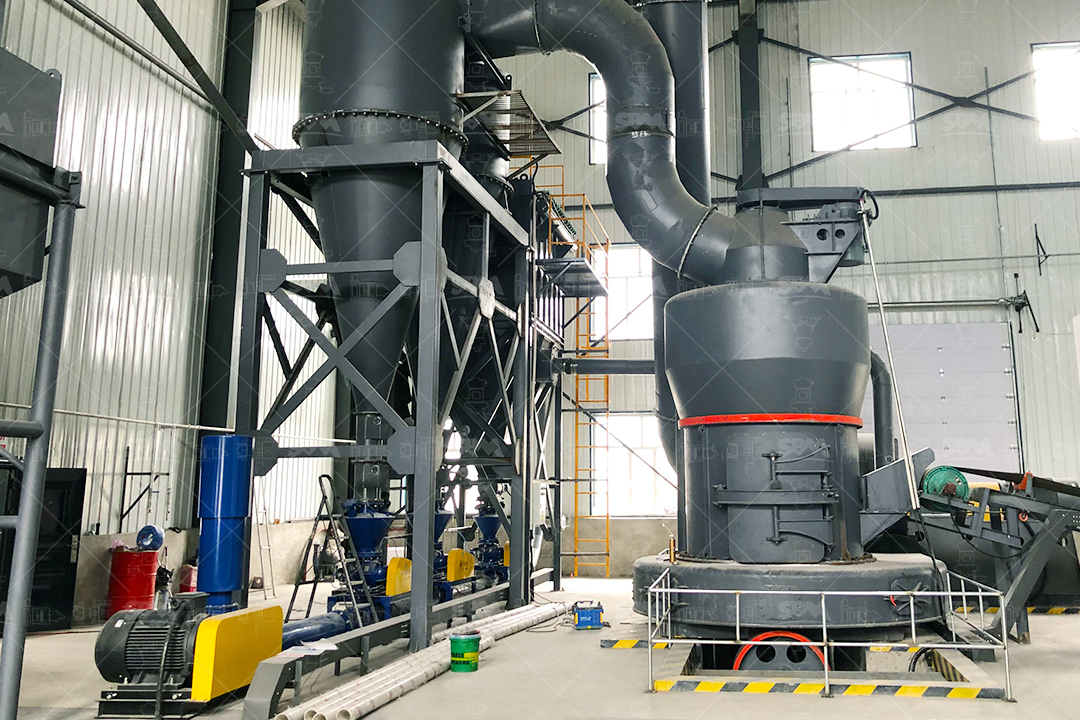
SBM’s engineers analyzed data from over 9,500 customer surveys and operational feedback from traditional mills before redesigning the system from the ground up. Launched as the MTW Series, this mill retains the pendulum principle but corrects each legacy flaw:
- Cone gear whole transmission: Instead of a horizontal shaft and pinion coupled via a large bull gear (which wasted space and energy), MTW integrates a bevel gear pair directly onto the main shaft. This achieves a transmission efficiency of above 98%, reduces backlash, and eliminates separate lubrication reservoirs. The enclosed oil bath lubricates gears and bearings simultaneously, solving the problem of oil leakage and contamination common in traditional mills.
- Arc air duct design: Traditional mills used a straight tangential air inlet, causing the airflow to lose kinetic energy when hitting the upper housing. MTW’s patent arc-shaped duct smoothly guides the air from the fan, preserving airflow velocity and ensuring that ground powder is promptly carried out. High-strength wear-resistant guard plates are welded inside to protect the duct face from particle erosion, doubling the service life of this critical section.
- Curved shovel blade and combined-type design: The blade is now a two-part assembly: a claw holder fixed to the main shaft and an interchangeable blade tip. Because the blade tip is the only wearing part, maintenance costs drop roughly 40% versus traditional designs. The tip’s curvature changes the material feeding angle to align with the roller’s rolling direction, reducing slippage and extending roller and ring life.
- Volute housing with no dead zones: The fan volute is designed without internal bolts or protrusions. This prevents material accumulation and allows smooth, efficient wind-driven particle transport.
Field results show MTW mills produce 30-400 mesh powders at 3-40 tph, with specific energy consumption about 20% lower than the same-capacity traditional Raymond mill. Furthermore, the internal oil lubrication system means there is no external oil pump or cooler; therefore, floor space is reduced by 30%, and routine upkeep is simplified.
3. Vertical Roller Mill (LM Series): The Paradigm Shift Toward Integration
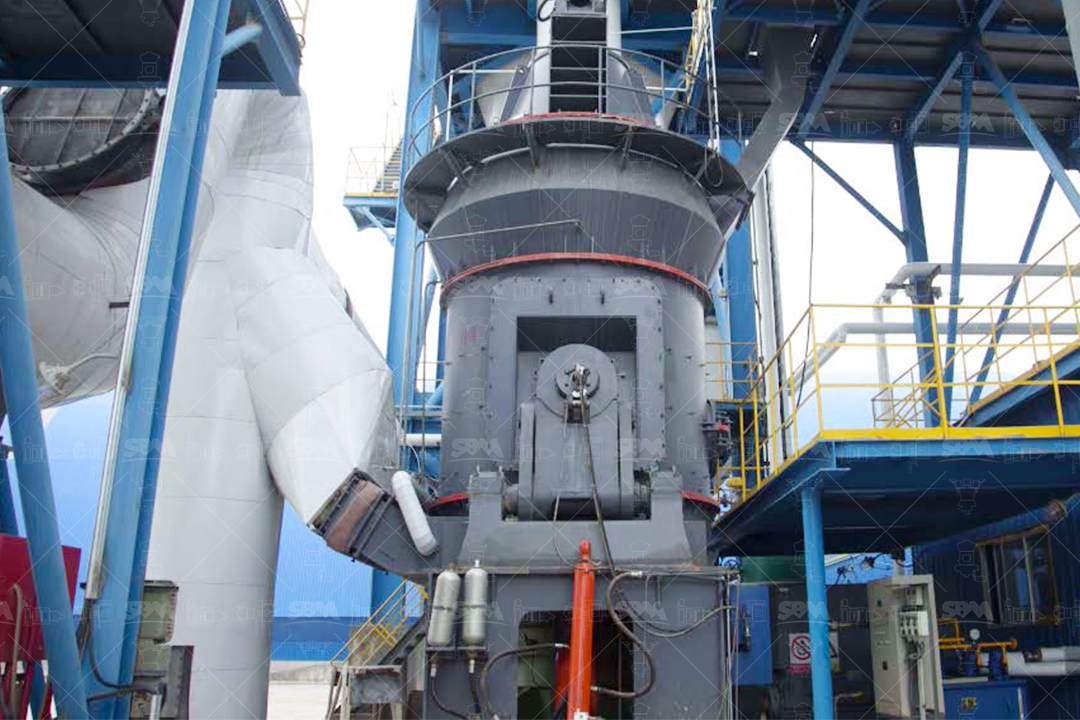
While Raymond mills improve the pendulum concept, the industry’s direction for large-scale grinding (up to 400 tph) shifted to a completely different geometry: the vertical roller mill (VRM). Inspired by the success of VRM in cement raw meal grinding, SBM’s LM series integrates three functions—crushing, drying, and classification—within a single vessel. The material falls from the feed chute onto a rotating grinding table, while two to four conical rollers, each pressurized by a hydraulic system up to 10 MPa, press and shear the material bed. Hot air (up to 450°C) enters through the annular nozzle around the table, simultaneously drying the material and transporting fines upward to the dynamically adjustable classifier. To solve the traditional VRM problems of external circulation and high pressure loss, SBM uses a low-pressure-drop louver ring and adjusts the table speed based on feed size.
Why operators switch: The LM vertical mill’s capital investment is roughly 50% lower than a ball mill system because it eliminates ball mill’s separate drying tower, elevator, and air classifier. Its building height is also lower, allowing outdoor installation in many climates. Operational expenses drop 30-40% when compared to a ball mill of equal capacity because grinding rollers never touch the table directly, creating a normalized metal loss rate below 5 g/ton of material (ball milling: 100-300 g/ton). The automatic control system uses PLC algorithms that adjust grinding pressure based on bed thickness and vibration sensors to prevent metal contact. For plant managers, the most significant benefit is the mill can handle feed moisture of 15-20% with no grinding issue, ideal for slag and coal. Environmental compliance is straightforward as the mill operates under negative pressure and has a built-in bag filter; measured noise levels at 1m are under 80 dB(A).
4. Ultrafine Mills: Meeting D97≤5μm Challenges
When product specifications demand 325-2500 mesh (D97 from 5 to 40μm), traditional mills fail for two reasons: (a) the classifier cannot produce fine cut points; (b) the grinding force is not sufficient to break micron-level aggregates. SBM’s SCM ultrafine mill and LUM vertical ultrafine mill were developed using specific technologies:
- High-speed multi-rotor classifier: SCM uses an integral vertical turbine classifier whose rotor speed reaches 2000 rpm, achieving an accurate cut point and preventing coarse particle spillover. LUM incorporates a multi-rotor classifier from Germany’s powder separation technology sector, enabling fineness adjustment via frequency control while maintaining full load efficiency.
- Abrasion-resistant grinding elements: Both mills use special alloy that with high chromium and ceramics, prolonging rolling ring life by 4-6 times compared to standard manganese steel, particularly for minerals like quartz and feldspar with Mohs hardness up to 7.
- Heavy rotor design and balanced grinding chamber: Because ultrafine grinding generates high centrifugal force, SCM features a large-diameter rotor with dynamic balancing, and the grinding chamber is free of any bolt that can loosen from vibration. This ensures stable operation even at full load with fineness of 2500 mesh, and specifically yields an energy consumption that is 30% lower than a jet mill for the same capacity.
LUM, resting on vertical mill architecture, integrates a drying function up to 10% moisture and may reach output of 10-70 tph—making it the preferred choice for industries such as GCC, talc, and plastic master-batch production. Both machines provide automatic feedback from a bulk density sensor that adjusts the classifier and feeder, minimizing manual intervention.
5. Ball Mill Modernization vs. Alternative Choices
Despite criticism, ball mills still hold a share where extremely hard materials (e.g., corundum) or high volume wet grinding is needed. SBM’s current ball mills are not the old, liner-breaking models. Through finite-element design and using self-lubricating composite liners, newer models reduce metal ball consumption by about 25%. Moreover, SBM’s dry ball mills are designed to operate as part of an external circuit with a dynamic air classifier, enabling D50 control at 44μm. For customers with existing ball mill lines, SBM suggests retrofitting with a vertical mill (LM) for new projects, while using ball mills only for reagents or where wet sand grinding is demanded. In most cases, we offer a total grinding solution—for example, a pre-grinding vertical mill followed by a ball mill finishing stage can reduce system energy consumption by 25-35%.
6. Industry Upgrade Paths and Selection Guidelines
To choose the appropriate mill, consider the following:
- Feed capacity and final fineness: Use MTW if the requirement is 80-400 mesh and capacity below 40 tph; use LM if the requirement is 200-400 mesh and capacity over 40 tph up to 400 tph; use SCM/LUM when product is ≤325 mesh.
- Material property: For materials with high moisture (>8%) such as slag or lignite, only vertical roller mill can dry and grind simultaneously. For ultrafine grinding of low-hardness minerals (talc, calcium carbonate), LUM is more energy efficient than SCM.
- Existing site layout: MTW has a compact footprint (16-30 m2), but LM requires silos for the raw feed due to its chute. If headroom is a constraint, SCM ultrafine, being only 9 m tall, sits comfortably in older factories.
- Operation labor: All modern SBM mills support remote control and KPI dashboards; however, the LM’s PLC based system contains a full auto pressure–vibration interlock, thus it is best for autonomous operation. MTW mills have a simpler relay circuit, which is easier for trainers new to machinery.
Furthermore, for new energy materials (e.g., lithium carbonate grinding for battery separators) and high-flow petroleum coke applications, SBM’s equipment meets high standard: the LUM can operate under inert gas type to prevent oxidation, and the MTW has an option of iron-free design with ceramic lining to ensure color purity in GCC processing.
7. SBM’s Global Service and Technological Support
With over 180 countries served and thousands of installed mills, SBM pledges more than just hardware. Each product is delivered with an expert system that uses predictive maintenance data, from bearing temperature history to classifier current trends. On-site commissioning includes performance-testing to achieve specified capacity and fineness; the mill can be installed outdoors, with corrosion protection for harsh atmospheres. Since 2023, most newly launched mills are capable of IoT connection, letting plant managers view real-time power consumption, wear rate, and product size distribution through a mobile app. SBM’s complete service network ensures spare parts (like grinding roller and blade) are then supplied from local warehouses near major port hubs. In summary, the technical evolution from Raymond to vertical and ultrafine mills has transformed powder processing plants from dusty, inefficient, labor-intensive sites into automated, energy-saving operations ready for Industry 4.0 and green manufacturing standards. By selecting a partner with a total solution approach, customers avoid compatibility issues and retain one accountable supplier for their entire grinding flow.
8. Conclusion
The strategic progression from traditional Raymond mills to modern vertical and ultrafine mills is not just a capacity increase—it is a paradigm shift to integrate drying, grinding, classification, and transport in one machine, to cut energy per ton by up to 40%, and to reduce civil investment by half. The future belongs to machines with digital control and environmental compliance. SBM’s MTW, LM, SCM, and LUM series exemplify the leading edge of this evolution, engineered from real customer problems. To decide which configuration meets your project’s budget and product target, consult our engineers who will evaluate materials and simulate full circuit performance. The mill vendors who remain stuck with old designs will not survive in the modern high-performance grinding market.
FAQ
1. My current Raymond mill consumes high energy but output is low for 325 mesh limestone. Should I replace it with MTW or LM?
For fineness of 325 mesh with capacity below 40 tph and feed size under 50mm, MTW Raymond mill is simpler and more affordable. It will lower energy by about 20% and provide better dust control. If you plan to expand capacity above 60 tph in future, LM vertical roller mill is preferred because its classifier is more efficient for high volumes.
2. We have a vertical hammer mill but it cannot grind slag with moisture 12%. What can you recommend?
Your material needs drying and grinding simultaneously. LM vertical roller mill has a drying capability up to 20% moisture and uses the hot air from the kiln system. The integrated system also reduces your floor space by 50% compared to adding separate dryer and hammer mill. Please contact our team with slag’s grindability and target fineness.
3. How can I prevent the blade and roller wear in my existing traditional Raymond mill? Every month we replace blades.
Wear is caused by the feeding angle. Traditional mill’s straight blade directs material at 90° to roll ring, causing abrasion. An SBM upgrade kit includes combined curved shovel blades made of wear-resistant cast iron, which spreads material in a swirling pattern and protects rollers. This alteration reduces blade replacement to every 6 months and roller/ring life should triple.
4. Is vertical roller mill suitable for ultrafine powder of D97≤10μm, e.g., heavy calcium carbonate product?
Yes, our LUM ultrafine vertical mill can achieve one-time product fineness from 325-mesh up to 2500-mesh (D97≤5μm). The multi-rotor classifier installed on LUM ensures accurate cut. For pure ultrafine output of that fineness, we suggest LUM12 model with capacity around 10-20tph for calcite.
5. I’ve heard that vertical mills create vibration when grinding softer minerals like talc, can I bypass that?
Vibrations happen only when bed height is unstable. SBM’s control system automatically adjusts grinding force according to current grinding plate thickness, maintaining stable bed formation even for very soft material. Also a special tensioning nozzle ring helps move soft material to groove areas, so LM machine operates smoothly with talc. We always run a trial installation on sent samples to verify performance before your purchase.


