

Calcium carbonate market trends: how can raymond mill technology adapt to high-end demands?
Published on: May 22, 2025
The global calcium carbonate market is undergoing a profound transformation. Increasingly, industries such as plastics, paints, paper, pharmaceuticals, and sealants are demanding ground calcium carbonate (GCC) with finer particle sizes, narrower distributions, higher whiteness, and consistent quality. Traditional Raymond mills, while reliable for coarse to medium grinding, often struggle to meet these high-end specifications. To stay competitive, manufacturers must upgrade to advanced milling solutions that combine the economy of Raymond technology with the precision of ultrafine grinding. This article explores how modern adaptations of Raymond mill technology—specifically European trapezium mills, vertical roller mills, and ultrafine mills—can bridge the gap between traditional capability and high-end market demands. It also addresses common customer pain points and offers practical guidance for selecting the right equipment.
_1790958249430.jpg)
1. The Shifting Landscape of Calcium Carbonate Demand
Calcium carbonate is one of the most widely used industrial minerals. In recent years, the market has shifted from commodity-grade fillers to specialty products. High-end applications require:
- Fineness: D97 between 5 and 45 microns, with some applications demanding sub-micron particles.
- Purity and brightness: Consistent CaCO3 content above 98% and whiteness over 95%.
- Particle shape: Controlled aspect ratio, especially for functional fillers in plastics.
- Low contamination: Minimal iron and other heavy metal content.
- Energy efficiency: Lower specific energy consumption per ton of product.
Traditional Raymond mills, with their pendulum roller and ring design, typically achieve fineness up to 200–325 mesh (74–45 microns). While adequate for many construction and agricultural applications, they fall short for high-end demands. This is where innovative adaptations come into play.
2. Limitations of Traditional Raymond Mills in High-End Processing
Classic Raymond mills have several inherent constraints:
- Fineness ceiling: Limited ability to produce products finer than 400 mesh consistently.
- Particle size distribution: Wide distribution curves, leading to inconsistent product quality.
- Wear and maintenance: Frequent replacement of grinding rolls and rings, especially when processing abrasive calcium carbonate.
- Energy inefficiency: High specific power consumption for fine grinding.
- Dust control: Older designs may struggle to meet modern environmental standards.
These limitations drive customers to seek alternatives. However, completely abandoning Raymond technology is not always necessary. Modern engineering has produced hybrid and upgraded designs that retain the simplicity and reliability of Raymond mills while delivering high-end performance.
3. Adapting Raymond Mill Technology: Key Innovations
3.1 European Trapezium Mill (MTW Raymond Mill)
The MTW Series European Trapezium Mill represents a direct evolution of the Raymond mill concept. It incorporates several patented technologies that address traditional shortcomings:
- Cone gear whole transmission: Higher transmission efficiency, lower space requirements, and reduced investment.
- Arc air duct design: Minimizes air energy loss and ensures efficient material transportation.
- Unique wear-proof perching knife: Combined-type shovel blade reduces wear part costs; only the blade needs replacement.
- Volute design: Improves wind-driven transmission efficiency and reduces maintenance.
With an input size of 0–50 mm and output adjustable from 30 to 400 mesh, the MTW mill can produce finer products than traditional Raymond mills. However, for ultra-high-end demands (below 400 mesh), additional classification or a different mill type is required.
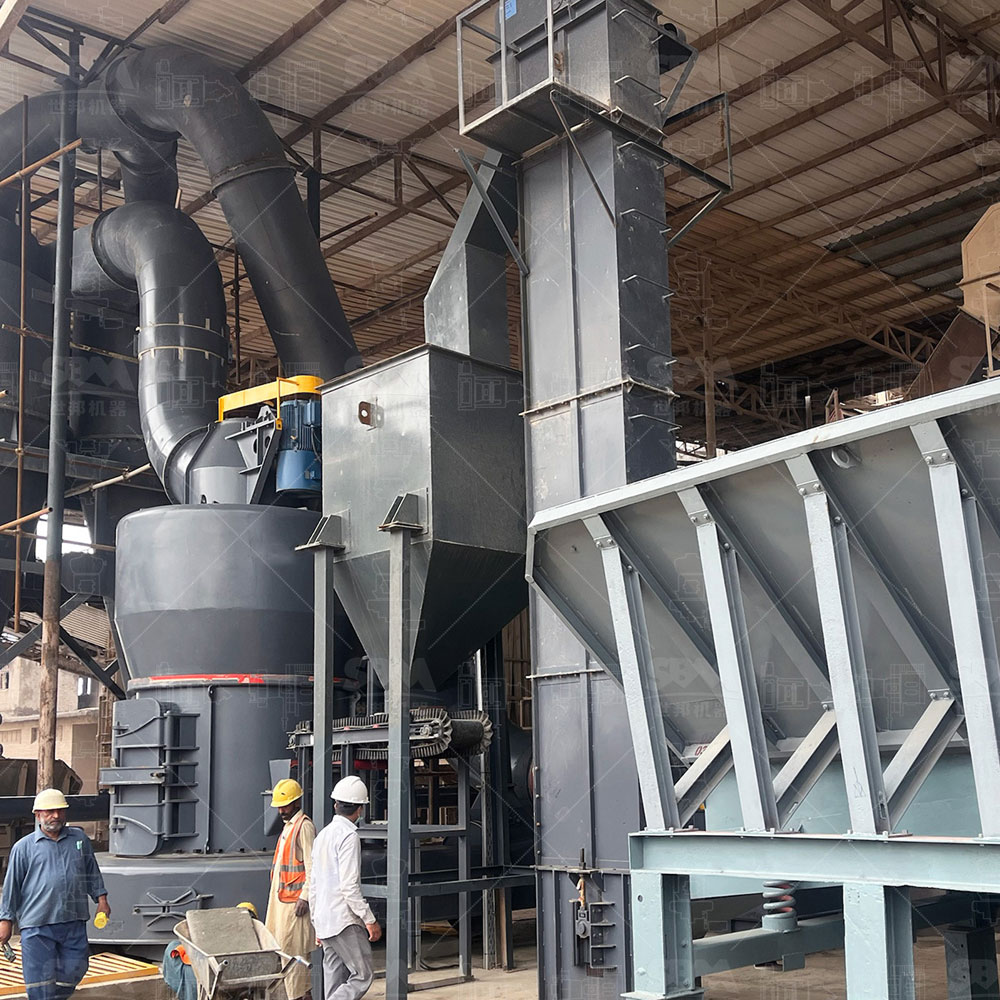
3.2 Vertical Roller Mill (LM Series)
Vertical roller mills have become the mainstream for large-scale calcium carbonate processing. The LM series integrates crushing, drying, grinding, powder separation, and transportation. Key advantages include:
- Small comprehensive investment: Compact layout, about 50% floor space of ball mill systems; can be arranged outdoors.
- Low operating costs: 30–40% lower energy consumption than ball mills; longer wear part life.
- Automatic control system: Expert automatic control enables remote and local switching, saving labor.
- High environmental protection: Fully sealed, negative pressure operation, meets national emission standards.
With input size 0–50 mm, output 30–400 mesh, and capacity up to 400 tph, the LM mill is ideal for large-scale GCC production. However, for products finer than 400 mesh, it may require secondary classification or an ultrafine mill.
3.3 Ultrafine Mills: SCM and LUM Series
When high-end demands require fineness beyond 400 mesh (down to 2500 mesh or D97 ≤ 5 μm), ultrafine mills are essential. The SCM series ultrafine grinding mill and LUM ultrafine vertical mill are designed for such applications.
SCM Series Ultrafine Mill:
- Fineness adjustable from 325 to 2500 mesh, one-time finished product D97 ≤ 5 μm.
- High output and low energy consumption: capacity more than twice that of jet mills, energy consumption lower by 30%.
- Efficient vertical turbine powder classifier for accurate cutting size.
- Heavy rotor design, special wear-resistant materials for roller and ring.
- Environmental protection: double powder collecting method, sound insulation, meets international standards.
LUM Ultrafine Vertical Mill:
- Integrates grinding, separation, and transportation.
- Unique grinding curves for roller shell and lining plate improve efficiency.
- Multi-rotor powder classifiers for customized fineness, no low-grade material.
- PLC/DCS automatic control for pressure adjustment, stable operation, remote control.
- Environmentally friendly: low vibration, low noise, fully sealed negative pressure.
These ultrafine mills can process calcium carbonate to meet the most demanding specifications, including use in PVC, cable, non-woven fabrics, and artificial stone.
3.4 Ball Mill Optimization
Although ball mills are mature technology, they still have a place in calcium carbonate processing, especially for wet grinding in mineral dressing. Modern optimizations include improved structure design and new materials to reduce spare parts costs. Dry ball mills are used for common powder, while wet ball mills are widely used in mineral dressing. However, for high-end fine products, ball mills are generally less efficient than vertical or ultrafine mills.
4. Matching Mill Technology to High-End Demands
To adapt to high-end calcium carbonate demands, a strategic approach is necessary:
- For 200–400 mesh products: MTW European Trapezium Mill or LM Vertical Roller Mill can provide improved efficiency and quality over traditional Raymond mills.
- For 400–1250 mesh products: LM Vertical Roller Mill with high-efficiency classifier, or SCM Ultrafine Mill.
- For 1250–2500 mesh products: SCM Ultrafine Mill or LUM Ultrafine Vertical Mill.
- For sub-micron or special particle shapes: LUM Ultrafine Vertical Mill with multi-rotor classifier, possibly combined with surface modification.
It is also important to consider downstream processes: coating, surface treatment, and classification can further enhance product value.
5. Customer Pain Points and How Modern Mills Address Them
Based on feedback from over 9,500 customers, SBM has identified recurring pain points in calcium carbonate processing:
- High energy costs: Traditional mills consume too much power. LM and LUM mills reduce energy consumption by 30–40%.
- Frequent maintenance: Wear parts need constant replacement. MTW's combined shovel blade and LUM's special materials extend service life.
- Inconsistent product quality: Wide particle size distribution. SCM and LUM mills offer precise classification for narrow distribution.
- Dust and noise pollution: Environmental compliance is mandatory. All modern SBM mills feature sealed negative pressure operation and sound insulation.
- Difficulty scaling up: Laboratory success doesn't translate to production. SBM provides complete grinding systems from individual units to full lines, with capacities from 0.5 to 400 tph.
- Lack of automation: Manual control leads to variability. PLC/DCS automatic control systems ensure stable operation and remote monitoring.
6. Future Trends and Strategic Recommendations
The calcium carbonate market will continue to demand finer, purer, and more consistent products. Raymond mill technology, in its evolved forms (MTW, LM, SCM, LUM), can meet these demands when correctly applied. Key recommendations:
- Invest in classification: Even the best mill needs a high-performance classifier to achieve narrow PSD.
- Consider total cost of ownership: Lower energy and maintenance costs often justify higher initial investment.
- Prioritize automation: Automatic control reduces labor and improves consistency.
- Partner with a total solution provider: SBM offers not just mills but complete process design, installation, and after-sales support in over 180 countries.
By adopting these advanced milling technologies, calcium carbonate producers can transition from commodity suppliers to high-end specialty product manufacturers, capturing higher margins and building sustainable competitive advantages.
Frequently Asked Questions (FAQ)
Q1: Can a traditional Raymond mill be upgraded to produce 800 mesh calcium carbonate?
A: Traditional Raymond mills are generally limited to about 400 mesh. For 800 mesh, you would need an ultrafine mill such as the SCM series or LUM series. However, you can retrofit a Raymond mill with a high-efficiency classifier to achieve finer products, but the capacity may drop significantly. It is often more cost-effective to invest in a dedicated ultrafine mill.
Q2: What is the typical energy consumption for grinding calcium carbonate to 1250 mesh?
A: Energy consumption depends on the mill type, feed size, and product fineness. For 1250 mesh (D97 ~10 μm), a vertical roller mill may consume 25–35 kWh/t, while an ultrafine mill may consume 40–60 kWh/t. Traditional ball mills would be much higher (80–120 kWh/t). SBM's SCM and LUM mills are designed for low energy consumption per ton.
Q3: How do I control particle size distribution to meet strict specifications?
A: Particle size distribution (PSD) is controlled by the classifier. Modern mills like the SCM series use a vertical turbine classifier with frequency control, allowing precise adjustment. The LUM series uses multi-rotor classifiers for customized fineness. It is also important to maintain stable feed rate and grinding pressure. SBM's automatic control system helps maintain consistent PSD.
Q4: What are the maintenance requirements for grinding calcium carbonate?
A: Calcium carbonate is moderately abrasive. Wear parts include grinding rolls, rings, and classifier blades. Maintenance intervals depend on operating hours and material abrasiveness. Modern mills like the MTW feature combined shovel blades that reduce replacement time. LUM mills use special wear-resistant materials. SBM provides remote monitoring and predictive maintenance to minimize downtime.
Q5: Can I process both coarse and fine calcium carbonate with one mill?
A: Yes, but with limitations. A vertical roller mill (LM series) can produce 30–400 mesh, covering coarse to medium-fine products. For finer than 400 mesh, you would need an ultrafine mill. Some plants use a two-stage setup: a LM mill for coarse grinding followed by an SCM or LUM mill for ultrafine grinding. This hybrid approach optimizes capacity and energy use.
For more information on adapting Raymond mill technology to your specific calcium carbonate project, contact SBM Machinery. With over 180 countries served and a full range of grinding equipment, we can help you meet high-end market demands efficiently and sustainably.


